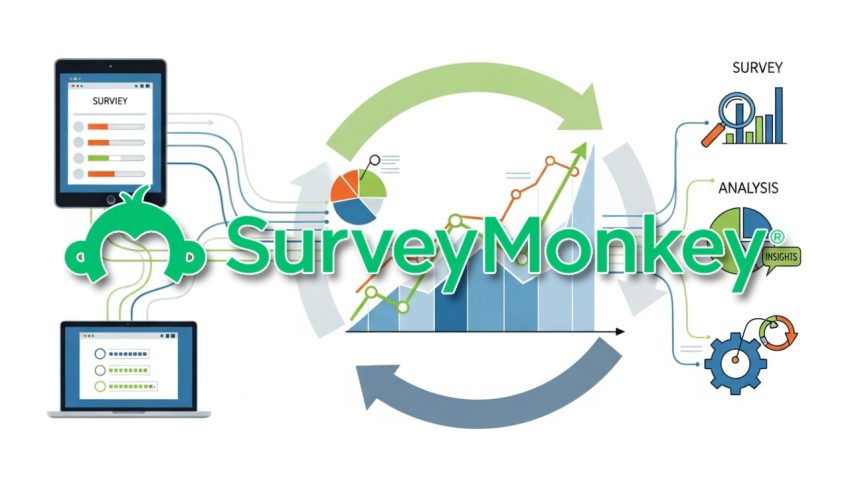
SurveyMonkey Review 2026: More Than Just a Questionnaire Tool
By The Insight Grid Content Team | April 22, 2026
In a world flooded with data, the ability to extract meaningful, actionable insights is what separates successful companies from the rest. SurveyMonkey has been a household name in the feedback space for decades, but in 2026, it has transformed into a sophisticated AI-powered Experience Management (XM) platform. It’s no longer just about asking questions; it’s about understanding the "why" behind the numbers. In this review, we’ll explore how SurveyMonkey is helping businesses close the feedback loop and drive innovation through data.
Introduction: The Pioneer of Digital Feedback
For many of us, SurveyMonkey was the first tool we ever used to create an online poll or a simple survey. It pioneered the self-service feedback model. However, as the digital economy matured, the needs of businesses became more complex. Simple data collection was no longer enough; teams needed real-time analysis, cross-platform integrations, and predictive modeling.
By 2026, SurveyMonkey (under its parent company Momentive) has successfully integrated advanced machine learning to automate the tedious parts of data analysis. From "SurveyMonkey Genius"—their proactive AI consultant—to deep sentiment analysis that parses thousands of open-ended responses in seconds, the platform is now a heavyweight in the enterprise research space. In this review, we’ll look at whether SurveyMonkey still holds its crown in an increasingly crowded market.
Tool Overview: What is SurveyMonkey Today?
SurveyMonkey is an end-to-one feedback management platform. It allows users to create, distribute, and analyze surveys at any scale. While it remains incredibly accessible for individuals, its enterprise-grade features now allow it to compete with the likes of Qualtrics and Medallia.
In 2026, the platform is divided into several specialized solutions:
- Customer Experience (CX): Net Promoter Score (NPS) tracking and customer satisfaction (CSAT) surveys.
- Employee Experience (EX): Engagement surveys, pulse checks, and 360-degree feedback.
- Market Research: Audience panel access for testing new product concepts or brand awareness.
- Product Experience (PX): In-app surveys to gather feedback during the user journey.
Key Features: The Power of AI Genius
The 2026 iteration of SurveyMonkey is defined by its "Genius" suite of AI tools. These aren't just cosmetic additions; they fundamentally change how research is conducted.
1. SurveyMonkey Genius: Your AI Research Partner
SurveyMonkey Genius acts as a real-time consultant while you build your survey. It analyzes your questions for bias, suggests more effective wording, and even predicts the "Completion Rate" based on the length and complexity of your survey. It ensures that you’re asking the right questions in the right way to get the most accurate data possible.
2. Automatic Sentiment & Theme Analysis
In the past, analyzing open-ended questions was a nightmare. In 2026, SurveyMonkey’s AI automatically categorizes open-ended text into "Themes" and "Sentiment" (Positive, Neutral, Negative). It can identify trending topics across thousands of responses, allowing you to see exactly what’s bothering your customers without reading every single comment.
3. Audience Panel & Market Insights
One of SurveyMonkey's biggest advantages is its native "Audience" panel. You can buy responses from a targeted group of people (segmented by age, job title, income, etc.) directly within the platform. This makes it possible to go from an idea to a fully analyzed market research report in less than 48 hours.
Pros and Cons
Why We Recommend It
- Unmatched Ease of Use: Still the most intuitive survey builder on the market.
- Massive Template Library: Thousands of expert-certified templates for any use case.
- Robust Integrations: Connects seamlessly with Salesforce, Microsoft Teams, and Slack.
- AI Insights: Genius suite saves hours of manual analysis time.
Potential Drawbacks
- Pricing Jumps: The gap between the Basic and Enterprise plans can be steep.
- Brand Customization: Full "White-label" features are restricted to higher tiers.
- Support: Priority support is only available for paid users.
Pricing Overview
SurveyMonkey offers a range of plans. By 2026, the focus has moved toward "Team" plans that encourage collaborative analysis.
| Plan | Best For | Key Feature |
|---|---|---|
| Basic | Individuals | Unlimited surveys, 10 questions/survey |
| Advantage | Small Teams | A/B testing, logic jumps, 24/7 support |
| Premier | Large Teams | Advanced analysis, multilingual surveys |
| Enterprise | Organizations | SSO, HIPAA compliance, custom integrations |
Common Use Cases
How are leading organizations using SurveyMonkey in 2026?
- Agile Product Development: Product managers send in-app surveys to users right after they use a new feature, gathering immediate feedback to iterate faster.
- Remote Employee Engagement: HR teams use "Pulse" surveys to monitor company culture and burnout levels in a distributed workforce, getting real-time alerts on dipping morale.
- Brand Tracking: Marketing teams use the Audience panel to run monthly brand health checks, tracking how their awareness and perception change relative to competitors.
Comparison: SurveyMonkey vs. Qualtrics
While Qualtrics is often seen as the "gold standard" for complex academic or enterprise research, it comes with a steep learning curve and an even steeper price tag. SurveyMonkey offers roughly 85-90% of the same functionality but at a fraction of the cost and with a much more friendly user interface. For most businesses, SurveyMonkey is the more "efficient" choice, providing the fastest path from question to answer.
Final Verdict: The King of Accessible Research
In 2026, SurveyMonkey has successfully shed its image as a "simple" tool and emerged as a serious enterprise contender. By leveraging AI to automate the complex parts of survey design and data analysis, it has made professional-grade research accessible to everyone. If you need a reliable, scalable, and intelligent way to listen to your customers or employees, SurveyMonkey is still the best in the business.
Our Score: 9.3/10
Frequently Asked Questions
Can I use SurveyMonkey for free?
Yes, SurveyMonkey offers a "Basic" plan that is free forever. It’s great for simple polls, but you’ll want to upgrade to a paid plan for advanced features like branching logic and data exporting.
How many people can I survey at once?
SurveyMonkey can handle millions of responses. If you don't have your own list, you can use SurveyMonkey Audience to find respondents from their global panel of over 175 million people.
Is my data secure and private?
Yes. SurveyMonkey uses enterprise-level encryption and is compliant with GDPR, HIPAA, and other global data privacy standards. You have full control over who can access your data.