The Rise of Decentralized Tech Ecosystems: Reclaiming the Digital Commons
By The Insight Grid Innovation Team | March 25, 2026
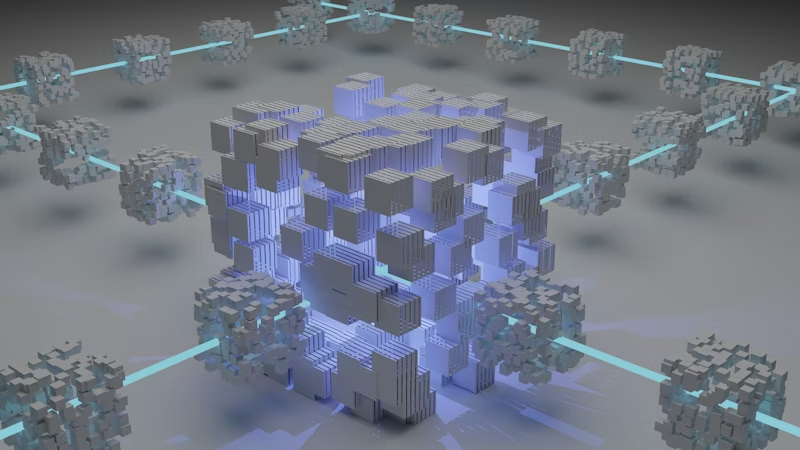
For the past two decades, the internet has been defined by centralization. A handful of "Big Tech" entities control the majority of our data, our communication channels, and our digital infrastructure. But a counter-movement is gaining momentum. Decentralized technology—often associated with Web3, blockchain, and peer-to-peer protocols—is challenging the status quo. These systems aim to return control to the users, creating a more resilient, private, and open digital commons. In this article, we explore the rise of decentralized ecosystems and what they mean for the future of the internet.
The Problem with Modern Centralization
Centralization has brought great convenience, but it has come at a cost. We have seen massive data breaches, opaque algorithmic manipulation, and the arbitrary de-platforming of users and businesses. When a single company controls a platform, they are the judge, jury, and executioner. Furthermore, the "walled garden" approach of traditional platforms stifles innovation, as developers are forced to build on terms set by the platform owners. Decentralization is an attempt to break these monopolies and create a more equitable digital landscape.
The Pillars of Decentralized Tech
1. Distributed Ledgers (Blockchain): Beyond currency, blockchains provide a way to record state and ownership without a central authority. This is the foundation of Decentralized Finance (DeFi) and self-sovereign identity.
2. Peer-to-Peer Storage: Technologies like IPFS (InterPlanetary File System) allowing data to be stored across a global network of nodes rather than on a single company's server. This makes data nearly impossible to censor or delete.
3. Decentralized Governance (DAOs): Decentralized Autonomous Organizations use smart contracts to allow communities to make decisions collectively, without the need for traditional hierarchy or management structures.
The Shift to User-Owned Data
One of the most radical promises of decentralization is the shift from "Platform-Owned" to "User-Owned" data. In a decentralized ecosystem, you carry your identity and your data with you across different applications. You decide who has access to it and for how long. This flips the traditional business model of the internet on its head; instead of companies owning your data and selling it back to you, you are the true owner of your digital footprint.
Overcoming the UX Barrier
Despite the potential, decentralized tech has long struggled with a major hurdle: User Experience (UX). Managing private keys, dealing with gas fees, and navigating complex wallet interfaces has kept these tools in the realm of the "tech-savvy." However, in 2026, we are seeing a new wave of "Abstracted Decentralization." Developers are building tools that offer the benefits of decentralization while maintaining the ease of use of traditional web apps. This "Web2.5" approach is the bridge that will bring decentralized tech to the mainstream.
Impact on Software Development
For developers, decentralized tech requires a fundamental shift in mindset. You are no longer building on a single database that you control; you are building on a shared, global public ledger. This introduces new challenges in terms of scalability, cost (gas fees), and technical complexity. However, it also unlocks new possibilities, like truly global, permissionless applications that can operate beyond the reach of any single government or corporation. The "Insight Grid" of the future is likely to be a mesh of these decentralized protocols.
The Role of Privacy and Stealth
In an increasingly surveilled world, decentralization is also about reclaiming privacy. Zero-Knowledge Proofs (ZK-Proofs) allow you to prove something is true (like your age or your bank balance) without revealing the underlying data. This is a game-changer for digital privacy, allowing for secure, private interactions on public networks. As we move toward 2030, privacy will not just be a feature; it will be a fundamental human right encoded into the very protocols we use every day.
Conclusion
The rise of decentralized tech ecosystems is a slow but steady revolution. It is an invitation to rethink how we build, how we interact, and how we value the digital world. While the road ahead is full of technical and regulatory challenges, the goal—a more open, private, and resilient internet—is worth the effort. At The Insight Grid, we are proud to be part of the community documenting and building this next chapter of human innovation. The grid is becoming more distributed, and we are here to help you navigate it.